Stop Multitasking: How the Weekly Batch Method Reclaims Over 10 Hours Every Month
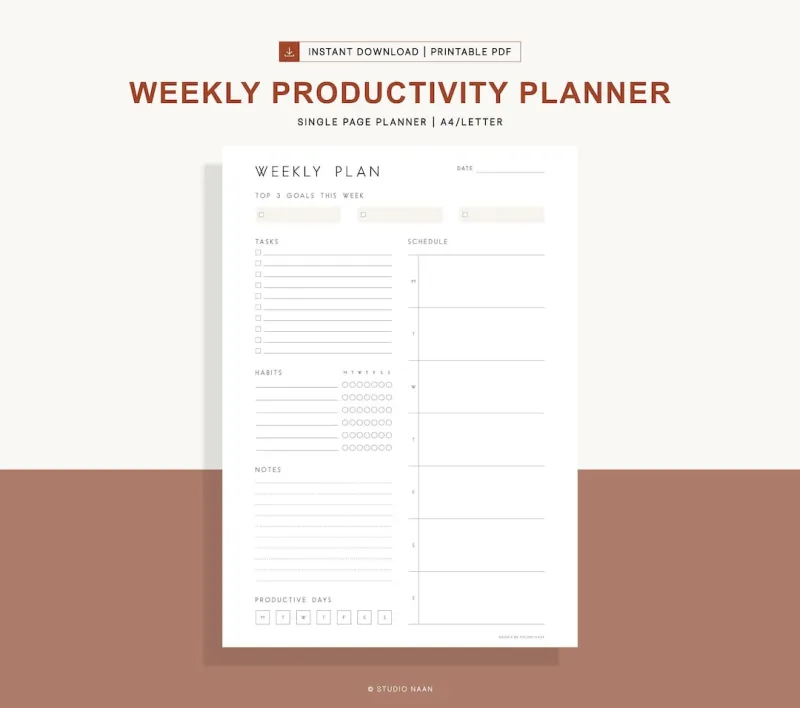
Photo: professional organizing weekly planner calendar desk productivity, via i.etsystatic.com
The Hidden Cost Nobody Is Measuring
Most professionals track their calendar hours. Very few track the time lost between them.
Every time a knowledge worker pivots from one type of task to another—answering an email, then jumping into financial analysis, then returning to a creative brief—the brain incurs what cognitive scientists call a "switch cost." Research from the American Psychological Association estimates that these transition penalties can consume up to 40 percent of a person's productive time on any given day. Multiplied across a five-day workweek, that is not a minor inefficiency. It is a structural drain on organizational output.
Task batching is the operational antidote. And when applied systematically through a weekly planning structure, it can realistically return ten or more hours to an individual's month—hours that compound into meaningful competitive advantage over the course of a year.
What Task Batching Actually Means
At its core, task batching is the practice of consolidating similar work activities into single, dedicated time blocks rather than distributing them sporadically throughout the day. Instead of checking email eight times between 9 a.m. and 5 p.m., a practitioner might designate two thirty-minute windows—one mid-morning, one mid-afternoon—exclusively for inbox management.
The principle extends far beyond email. Content creation, financial reconciliation, client calls, administrative approvals, and internal reporting all qualify as batchable categories. The defining criterion is cognitive similarity: tasks that draw on the same mental framework, toolset, or knowledge domain are natural candidates for grouping.
When batching is organized around a weekly rhythm rather than a daily one, its benefits scale substantially. This is the foundation of what productivity professionals increasingly refer to as temporal blocking—the deliberate architecture of one's week before it begins.
The 72-Hour Planning Window
The most effective batching practitioners do not plan their week on Monday morning. They plan it on Friday afternoon or Sunday evening—roughly 72 hours before the bulk of execution begins.
This advance window matters for two reasons. First, it allows the subconscious mind to begin priming for the week's cognitive demands, a phenomenon well-documented in occupational psychology literature. Second, it creates enough distance from the current moment to evaluate the week's priorities with strategic clarity rather than reactive urgency.
The practical framework works as follows:
Step 1: Categorize your recurring task types. Before you can batch, you need a clear taxonomy of the work you actually do. Spend fifteen minutes listing every recurring task from the past two weeks. Then group them into no more than five cognitive categories—for example: deep analytical work, communication and correspondence, creative production, administrative processing, and relationship management.
Step 2: Assign each category a dedicated weekly block. Map your five categories to specific half-day or full-day blocks on your calendar. Protect these blocks as you would a client meeting. Deep analytical work, which demands the highest cognitive load, belongs in your peak-energy hours—for most people, this is mid-morning.
Step 3: Enforce a 48-hour freeze on batch blocks. Once your week is planned, resist the urge to fragment your blocks for the first 48 hours. This period allows the rhythm to stabilize and interruptions to reveal themselves as genuinely urgent versus merely habitual.
Step 4: Conduct a Friday audit. At week's end, note which batches held and which were disrupted. Over four weeks, patterns will emerge that allow you to refine your categories and block placements.
The Math Behind the Monthly Savings
Consider a mid-level marketing manager at a company with 50 employees. She currently checks email reactively, switches between project management tools and spreadsheets throughout the day, and handles administrative requests as they arrive. Conservative estimates suggest she experiences 15 to 20 context switches per day.
At an average switch cost of two minutes per transition—a figure supported by research from the University of California, Irvine—she is losing 30 to 40 minutes daily to cognitive re-engagement alone. Over 22 working days in a typical month, that totals between 11 and 14.7 hours.
Now apply batching. By consolidating email into two daily windows, grouping all spreadsheet work into Tuesday and Thursday mornings, and reserving Monday afternoons for administrative tasks, she reduces her daily context switches from 18 to approximately six. Her monthly switch-cost loss drops to under four hours. The recovery: 10 or more hours per month.
Annualized, that is more than 120 hours—the equivalent of three full workweeks returned to productive use.
US Companies Putting This Into Practice
Several American organizations have formalized batching at the team level with measurable results.
A mid-sized software firm based in Austin, Texas implemented what their operations director called "theme days"—Monday for strategy and planning, Tuesday and Wednesday for deep development work, Thursday for cross-functional collaboration, and Friday for review and communication. Within one quarter, the team reported a 23 percent reduction in self-reported meeting fatigue and a notable improvement in sprint completion rates.
A Chicago-based financial advisory practice restructured its advisor workflows so that all client-facing calls were scheduled exclusively on Tuesdays and Thursdays. The remaining days were protected for research, analysis, and document preparation. Senior advisors reported recovering an average of 2.5 hours per week previously lost to mental gear-shifting—time that was redirected toward business development activities.
These outcomes are not anomalies. They reflect a consistent pattern: when teams align their work architecture with the brain's natural operating preferences, throughput increases without requiring additional hours.
Common Objections—and How to Address Them
"My role is too reactive for batching." This is the most frequently cited resistance, and it deserves a direct response. Even highly reactive roles—customer support leads, operations managers, executive assistants—contain a meaningful proportion of recurring, predictable tasks. Batching does not require eliminating responsiveness; it requires quarantining it. Designating specific response windows preserves agility while reducing the cognitive penalty of constant availability.
"My team won't respect the blocks." This is a culture issue before it is a scheduling issue. Batching succeeds when leaders model it and communicate the rationale clearly. When colleagues understand that a blocked calendar is a productivity asset rather than an act of disengagement, adoption follows.
"I tried time-blocking before and it didn't work." Time-blocking and task batching are related but distinct. Time-blocking assigns hours to tasks. Task batching assigns tasks to cognitive categories first, then to hours. The sequencing matters. Without categorization, time blocks become arbitrary containers that still invite context-switching.
Building a Sustainable Batching Practice
The goal of task batching is not to rigidify your workday. It is to create intentional structure that serves your highest-priority outcomes rather than the loudest incoming demands.
Start with a single category. Choose the one type of work that currently feels most fragmented—email, reporting, or creative output—and batch it for two weeks. Measure the difference in both time recovered and subjective focus quality. Then expand from there.
The professionals and teams who sustain this practice longest are not those who implement it perfectly from day one. They are the ones who treat their weekly planning session as non-negotiable—a strategic investment of 20 minutes that pays dividends across every hour that follows.
At Task Boosters, we work with individuals and organizations to design work systems that reduce friction and amplify output. Task batching is one of the highest-leverage tools in that system. The hours are already there. The framework exists to reclaim them.